2026-06-26
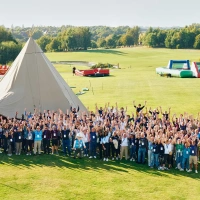
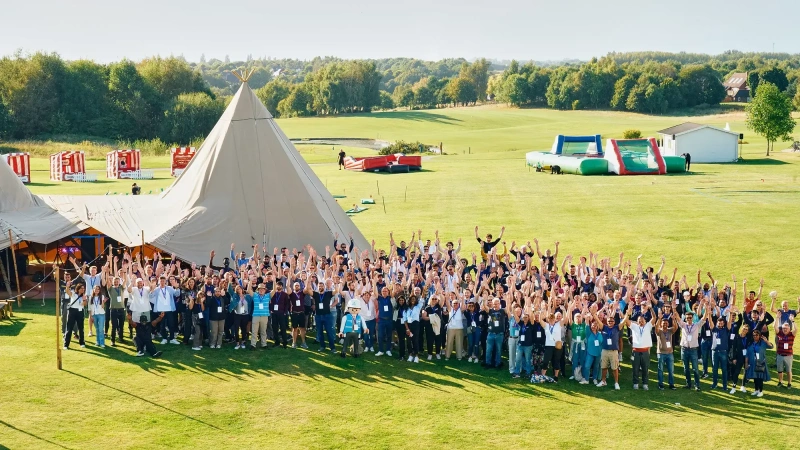
At a corporate event with 400 attendees, the challenge isn't fitting everyone into a room or an outdoor venue. The real question is how to make sure no one fades into the background. Experience shows that most large-scale events fail because the program is optimized for 20-30 people, while everyone else ends up passively watching from the back of the room or a screen.
Why is 400 so much harder than 40?
Group dynamics don't scale linearly with headcount – they scale exponentially in complexity. With forty people, a skilled facilitator can maintain eye contact with everyone and instantly notice if someone disengages. With four hundred, that's physically impossible for a single person. This means scaling up isn't just doing more of the same – it requires an entirely different program architecture.
Breaking into small groups as a core principle
The key to engagement is never treating 400 people as one block. Instead, we split them into micro-teams of 8-15 people who work in parallel within a shared narrative. This way, everyone has a role and a voice within their own team, while the event still feels like one unified shared experience.
Enough facilitators – not a luxury, a necessity
One of the most common mistakes in large-scale team building is having too few facilitators. If a 15-person team doesn't get a dedicated, trained facilitator, the group is left to its own devices, and a few dominant personalities take over while others withdraw. At LifeTraining events, every small team gets its own facilitator who knows the task, watches the group dynamic, and gently steps in when needed.
Technology in service of engagement
With 400 participants, communication and live feedback become a serious logistical task. Digital tools – live leaderboards, mobile-based task distribution, real-time score tracking – help every team see where they stand compared to others, which further boosts engagement and competitive spirit.
What should organizers pay attention to?
- Tasks should be scalable – the same challenge needs to work for both 8 and 15-person teams
- Have enough facilitators – rule of thumb: one facilitator per 12-15 people max
- Keep the opening and closing moments shared, so the large-scale experience is preserved
- Build in buffer time for movement, registration, and group formation
LifeTraining has built years of experience specifically in this area – organizing large-scale events that still deliver a personal level of engagement. A well-designed structure means participants experience the day not as part of a crowd, but as an active member of their small team.

2026-09-11

2026-09-01


2026-08-14


2026-07-16